

HIPAA Real-Time Server
The best way to become Core® Compliant
The Affordable Care Act (ACA) requires insurance carriers to follow the CAQH® CORE® Operating Rules since 2013 and provide real-time eligibility and claim status information.
Additional Features
Overview
he HIPAAsuite RealTime Server is a self-hosted web service that enables the exchange of EDI transaction sets in real-time and batch mode. It full-fills all CORE requirements and is a certified software product by the CAQH.
Our CORE® certified HIPAA RealTime Server uses SOAP and MIME protocols to deliver electronic responses in less than 10 seconds.
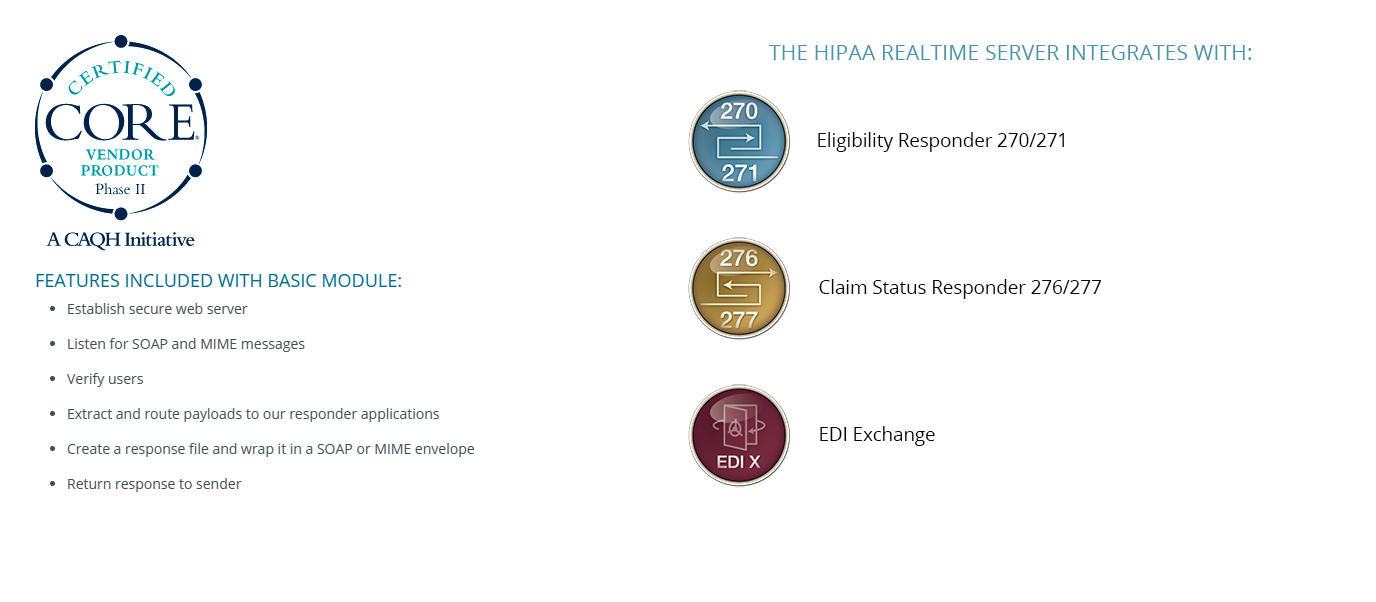
The HIPAA RealTime Server integrates with the HIPAA Eligibility Responder, HIPAA Claim Status Responder and the EDI Exchange to implement real-time capabilities. Load your eligibility and claim status data into our tables, set up the program and become compliant with the CORE rules and the ACA in a short time.
The HIPAAsuite RealTime Server complies with the Phase I and II CORE rules which are mandated for Health Plans and State Medicaid for compliance with the Affordable Care Act (ACA).
Phase I And II Core
The Coalition for Affordable Quality Healthcare (CAQH) is a group of stakeholders in the healthcare industry who determined that real-time transactions will cut costs and increase the efficiency of the healthcare system.
CAQH established the Committee on Operating Rules for Information Exchange (CORE). CORE is dedicated to the development and adoption of national operating rules for healthcare administrative transactions.
The Affordable Care Act (ACA) requires insurance carriers to follow the CAQH® CORE® Operating Rules since 2013 and provide real-time eligibility and claims status information.
The providers in the healthcare industry are demanding from payers to have real-time capabilities because they save them a lot of money. This technology shift will make the whole industry more efficient and save your organization a lot of money over time with an affordable investment. Providers need to know at the time of service whether a patient is covered by an insurance policy. Insurance payments are refused because the patient is not covered or a particular service isn’t covered. Obtaining a patient’s eligibility and benefits status in real-time is of great importance to eliminate later disappointments.
Secondly it is important for providers to find out the status of claims that were submitted to carriers.
Providers usually have a staff of people who spend their day hunting down missing payments for claims and waste hours on the phone to find out why a particular claim has not been paid and whether it should be resubmitted.
Getting eligibility and claim status information in real time, without human interaction, will save countless hours.
Try our HIPAA Real-Time Server and save money. Download the free trial today!
HTTPS and mTLS
HIPAA REALTIME SERVER supports HTTPS (Hypertext Transfer Protocol) for encrypted communication to protect sensitive data during transmission and mTLS (Mutual Transport Layer Security). This protocol requires mutual authentication between the client and server to establish a secure connection.
Design Principals
The CORE Connectivity Rules describe the complete data exchange between providers and carriers.
It offers two processing modes:
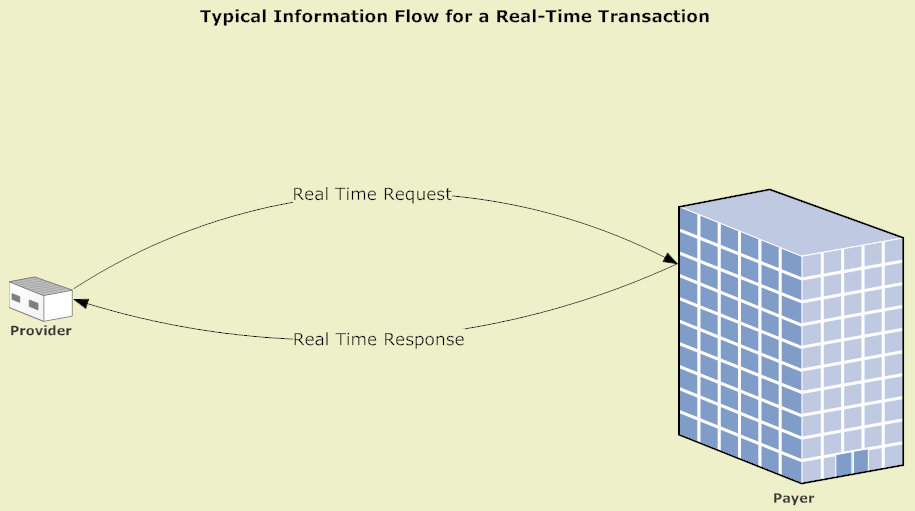
Real-time mode
Batch mode
It offers two transport protocols:
SOAP (XML-based)
MIME (email-related)
Requests have to be delivered within 20 seconds to qualify for real-time.
Discover the easiest way to CORE compliance with our HIPAA Real-Time Server.
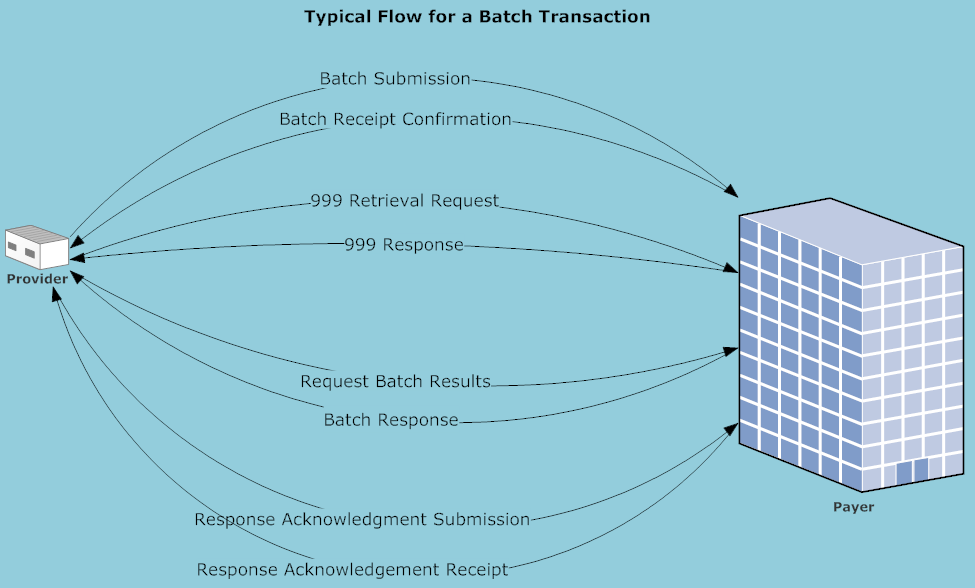
Typical Flow for a Batch Transaction


What type of throughput can we expect with HIPAA Suite?
For example, on a server with a 64 core processor and a RAM of 64.0 GB and running at 2.40 GHz, we are achieving a response time of 3-4 seconds, and with 5 simultaneous calls, about 80 requests per minute.
What type of capacity planning should we have in place to handle the request volume? How big of a server should we plan for?
You can start with the server as we described above, and in case you need more, please talk to us.
Can we start Real Time Server with a dedicated domain account?
The user who’s running the software should have administrator role for configuring and running Realtime Server. If you want to use a dedicated domain account, you need to make sure that account has permission to read and write in file for settings and run Windows services. The user needs to be logged on in a local system account. Like In shared screen from installed Windows service properties.
What considerations should we have for database size?
As you might expect, the more traffic you have, the larger your database will be; however, we have an archiving process that can be configured daily to migrate historical data to another database, keeping the working data compact and fast.
What are the exact DB requirements for the Real Time Server software (what tables does the user need access to for that software)?
The server on which the Realtime server is installed should also have the database server to avoid network traffic. Of course, our HIPAAsuite responder applications and all should be on the same physical machine.
ADD THIS PRODUCT TO YOUR CONFIGURATION
Handle payments with the HIPAA Claim Payment Master.
Create 835 payment advice transactions
Pay your claims with ACH
View and understand 835 EDI files
Export and save 835 EDI files
Why Choose HIPAAsuite?
SINGLE USER
Perfect for independent practices. Professional grade tools at an accessible price point.
Multiple Users
The first license at regular price, plus 60% off all additional seats in the same organization.
Most PopularSite License
Unlimited enterprise-wide access at only 6X the single-user cost. Unbeatable ROI.