|
<< Click to Display Table of Contents >> What is MTOM |
  
|
|
<< Click to Display Table of Contents >> What is MTOM |
|
MTOM is a W3C (World Wide Web Consortium) Recommendation designed for optimizing the electronic transfer of attachments to and from web services. With web services-based SOA (Service Oriented Architecture) now being deployed across the world, transmitting attachments such as MRI Scans, X-Rays, Design Documents, and Business Contracts using SOAP messages has become a common practice. Through electronic transmission of documents, corporations can realize significant cost savings and better service levels by eliminating the use of postal mail. Paper-based manual tasks can be replaced with simple and efficient electronic processes where binary data can be transmitted between organizations through standards such as MTOM.
MTOM provides an elegant mechanism of efficiently transmitting binary data, such as images, PDF files, MS Word documents, between systems. The Figure below shows the steps involved in transmitting data between a Consumer and Producer using MTOM.
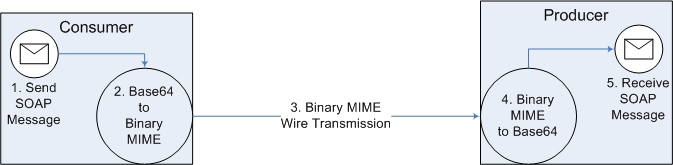
SOAP transmissions encode binary data as BASE64. Sending it as BASE64 increases the size of the binary data. With MTOM, the SOAP messages are sent as MIME messages with the BASE64 encoding being replaced with a placeholder. The binary data is then placed between delimiters (which happens for each piece of binary data), and then placed at the end of the SOAP request, a reference . The binary data is then sent unencoded. MTOM also determines whether sending it as a MIME message will increase the size of the SOAP call and if doesn't provide a saving, it will send it as a normal SOAP message.
The Consumer or Client application begins by sending a SOAP Message that contains complex data in Base64Binary encoded format. Base64Binary data type represents arbitrary data (e.g., Images, PDF files, Word Docs) in 65 textual characters that can be displayed as part of a SOAP Message element.
A sample SOAP Body with Base64Binary encoded element
<tns:data> is as follows:
<soap:Body>
<tns:ByteEcho>
<tns:data>JVBERi0xLjYNJeLjz9MNCjE+DQpzdGFyNCjEx0YNCg==</tns:data>
</tns:ByteEcho>
</soap:Body>
An MTOM-aware web services engine detects the presence of Base64Binary encoded data types, <tns:data> in our example, and makes a decision – typically based on data size – to convert the Base64Binary data to MIME data with an XML-binary Optimization Package (xop) content type. The data conversion results in replacing the Base64Binary data with an <xop:Include> element that references the original raw bytes of the document being transmitted. The raw bytes are appended to the SOAP Message and are separated by a MIME boundary as shown below:
<soap:Envelope>
<soap:Body>
<tns:ByteEcho>
<tns:data><xop:Include href="cid:1.633335845875937500@example.org"/></tns:data>
</tns:ByteEcho>
</soap:Body>
</soap:Envelope>
--MIMEBoundary000000
content-id: <1.633335845875937500@example.org>
content-type: application/octet-stream
content-transfer-encoding: binary
The raw binary data along with the SOAP Message and the MIME Boundary is transmitted over the wire to the Producer. The Producer then changes the raw binary data back to Base64Binary encoding for further processing. With this conversion between Base64Binary and raw binary MIME types, MTOM provides two significant advantages:
Efficient Transmission: Base64Binary encoded data is ~33% larger than raw byte transmission using MIME. MTOM therefore reduces data bloat by converting Base64Binary encoding to raw bytes for transmission.
Processing Simplicity: Base64Binary encoded data is composed of 65 textual characters. The data is represented within an element of a SOAP message. Security standards such as WS-Signatures and WS-Encryption can directly be applied to the SOAP Message. Once such operations are performed, the Base64Binary data can be converted to raw bytes for efficient transmission. Securing document transmission via SOAP, therefore, does not require additional standards for securing MIME-based attachments.