Electronic Data Interchange (EDI) is standardized in the USA and behind much of the economic success of this country. From ATM transactions over phone bills between carriers to Wal-Mart's supply chain, commerce relies on standardized electronic data interchange. Its rules and standards are administered and maintained by the National Bureau of Standards within the X12 working group.
The HIPAA act mandates eligibility transactions need to be transmitted in a standardized way. The 270 and 271 transaction sets deal with the eligibility to medical insurance benefits. Typically a provider would send out a 270 request for eligibility benefits and a payer either directly or through a clearing house reads this request messages and sends back a 271 eligibility response message listing all the available benefits or the specific subset that what questioned. The Affordable Care Act (Obama Care) mandates that payers provide real time responses to such requests.
What is an EDI file?
X12 is an ASCII standard. This means that all the content of a transmission consists of ASCII characters. ASCII or text files can be viewed and edited with a regular text editor. Below you see an EDI file opened with Notepad. It opens alright but since EDI does not use line feeds and carriage returns to mark the end of a line, an EDI document is usually very hard to view.
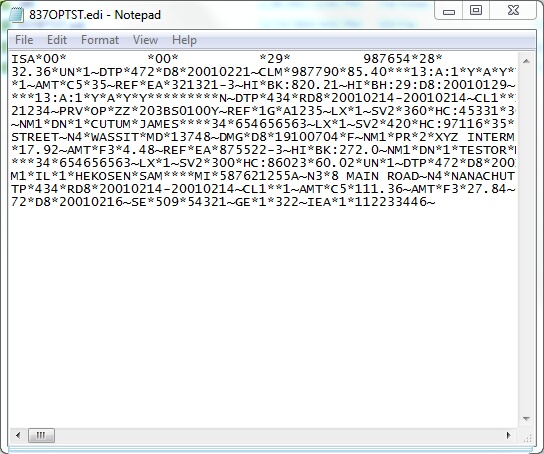
A view of raw EDI data
Making sense of this data stream is quite difficult. Even if we display the data in a special EDI Editor the untrained cannot make out what it means.
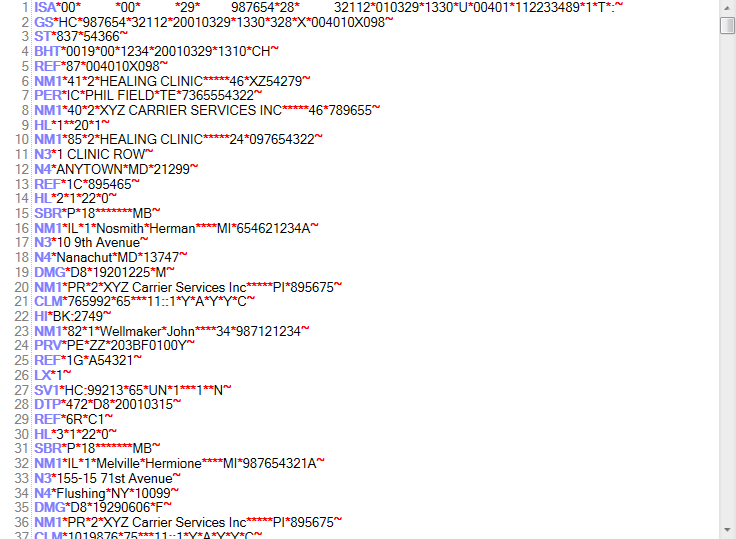
EDI data displayed in the built-in EDI Editor
To fully explain the structure of EDI is not part of this introduction but we can point out some of the features. Each line in this editor screen is called 'Segment'. Every EDI file starts with the ISA segment. Each segment has multiple elements which are separated by the element separator which in this case is the '*'. Sometimes elements themselves are subdivided into sub-elements, here it is the colon ':'. Each segment is terminated by the segment delimiter, in this case the tilde '~'. The rules of a particular transaction set are determined in the so called implementation guide.