|
<< Click to Display Table of Contents >> What is EDI? |
  
|
|
<< Click to Display Table of Contents >> What is EDI? |
|
X12 is an ASCII standard. This means that all the content of a transmission consists of ASCII characters. ASCII or text files can be viewed and edited with a regular text editor but since EDI does not use line feeds and carriage returns to mark the end of a line, an EDI document is usually very hard to view.
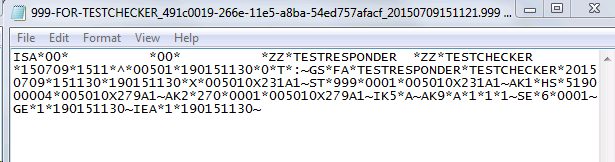
A view of raw EDI file data.
As you can see in the previous figure, it is quite difficult to discern the individual data elements within the ASCII text file. One needs an EDI Editor to get a more meaningful representation of an EDI file. The HIPAA 999 Master has a built-in EDI Editor. Here is how this file is displayed in it:
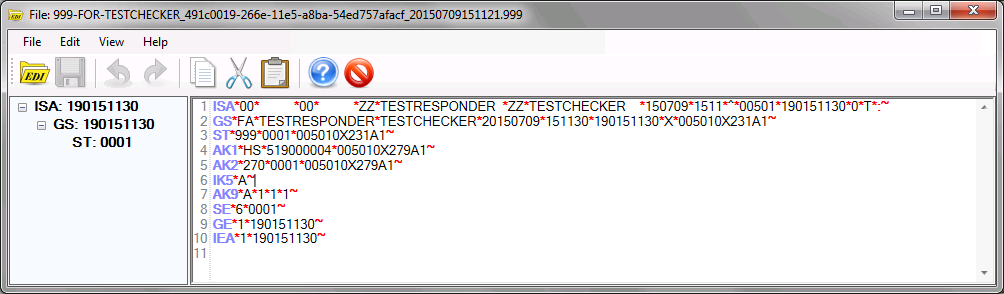
The same data viewed with HIPAA Claim Master's built-in EDI Editor
When you view this ASCII data with a special EDI editor, the individual data segments are visible but it is still difficult to understand the content of the form. EDI tries to abbreviate complex descriptions into short codes; and without a translator only true experts know what this means. This is where the HIPAA Claim Master is indispensable. Its built-in translator parses the significant data elements from the EDI file and prints the data into the well-accepted medical forms HCFA-1500 and UB92 as well as the ADA dental forms. The program's output can be screen, paper or image file (TIFF and PDF) as well as data rows in external tables.