EDI stands for Electronic Data Interchange, which is the electronic transfer of information between computers in a standard format. It allows for the exchange of information in an efficient and cost-effective way between computers, without the need of human interaction. EDI functions through a defined set of standards for transmitting information, allowing data to be interpreted correctly, independent of the platforms used on the computers that transmit and receive the data.
EDI plays an essential part in the economic success of the country. The government through its National Bureau of Standards is the guardian of the rules and details of the different EDI transactions for each involved industry. This technology has been used in the banking and long-distance phone call industry to tremendous advantage.
We interact with EDI transactions all the time; one example being automatic teller machines (ATM). When we enter information to an ATM, it collects the input data and creates an EDI file that is then routed to a bank. The bank receives the request, and a response is sent back to the ATM enabling us to withdraw money from the ATM.
HIPAA EDI
In 1996, the Health Insurance Portability and Accountability Act (HIPAA), was the first attempt to create nationwide rules to enact administrative simplification and make the process of information exchange between healthcare payers and providers more efficient by employing EDI transactions.
By 2003, all healthcare entities were required by law to fully implement EDI on their transactions. The government, as the largest payer in the system through the programs of Medicaid and Medicare demanded that from there on, they would only accept standardized electronic transactions. This decision, based on the HIPAA law, changed the system profoundly. In the year 2000, 6,000 healthcare payers were in business. By 2020 only 1,300 remained, however, they process a higher number of claims electronically.
So let's go a little bit deeper into the technology of EDI and demystify it.
EDI X12 is an ASCII standard. This means that all the content of a transmission consists of ASCII characters. ASCII or text files can be viewed and edited with a regular text editor, such as Notepad, but since EDI does not use line feeds or carriage returns to mark the end of a line, an EDI document is usually hard to understand.
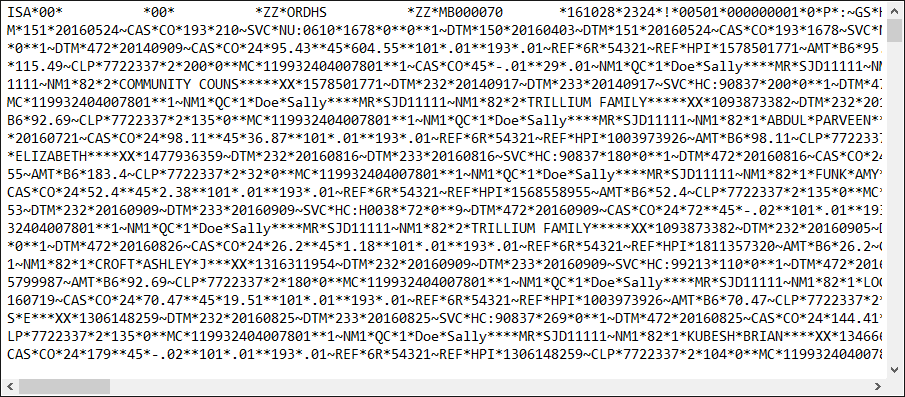
EDI file in Notepad
Making sense of raw EDI files is hard because they are made for computers and not intended for human interpretation. As you can see in the previous image, it is quite difficult to discern the individual data elements within the ASCII text file on a regular text editor. This is because Notepad is made for text documents that have lines and paragraphs. EDI files have segments, not unlike lines, these segments have elements and are bundled into loops.
A few years ago, we developed our HIPAA EDI Editor, a tool that conveniently formats and transforms these complex raw EDI files into easily readable files, allowing the user to view organized data without the need of Notepad. It supports line numbering, color coding, editing, find and replace, and has a tree view control that allows for easy navigation pane.