|
<< Click to Display Table of Contents >> Displaying 820 EDI Files |
  
|
|
<< Click to Display Table of Contents >> Displaying 820 EDI Files |
|
After opening a file and leaving the default output mode "Screen", click on the "Run" button. With the output mode set to "Screen," the payment records are displayed on the screen. On pressing the "Process" button, the program reads through the EDI file and parses the individual records into a memory array. Once the parsing is finished the content is ready to be presented in a window.
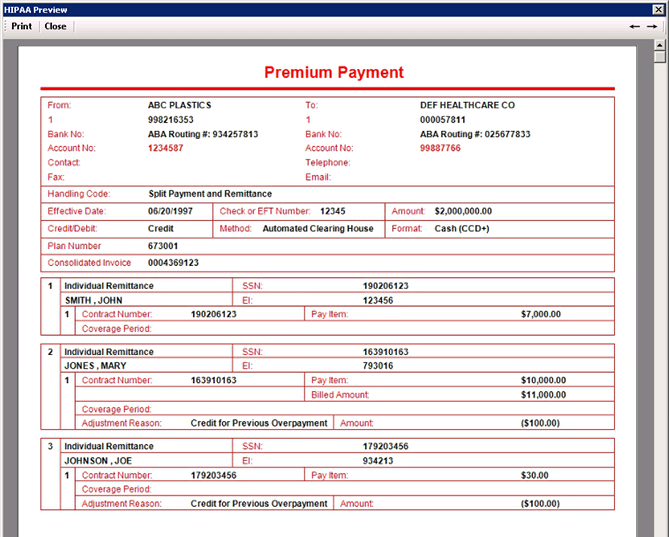
Premium payment records of the "Individual Remittance" type
You can see the listing of the insured persons together with policy details.
Below you can see how a summary remittance is displayed. The data structure of those two versions of the 820 are significantly different.
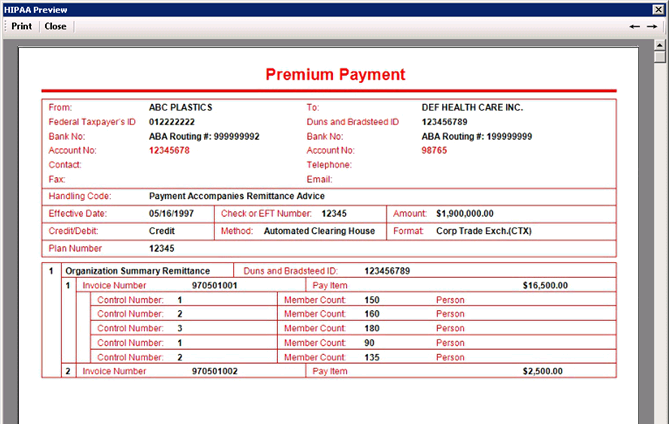
A premium payment record of the "Summary Remittance" kind
The screen display of payment records is most often several pages long. Since the HIPAA Premium Payment Master keeps the payment records in memory, you can easily navigate through the records back and forth.
The navigation button on top of the display screen for premium payment records.
New TRN segments, which means new transactions trigger the renewed display of the header record.
We basically have two quite different remittances that can be formatted into the 820 transaction set.
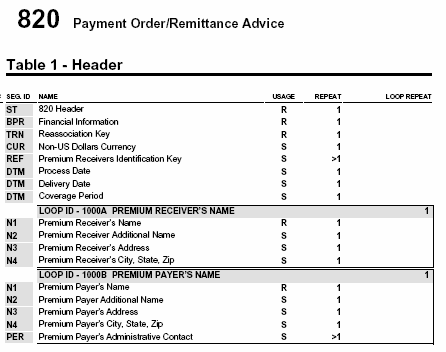
Above is the listing for the header part of the 820 record which is shared by both formats. We can have only one payment (BPR) within an ST-SE loop.
There is the "Summary Remittance":
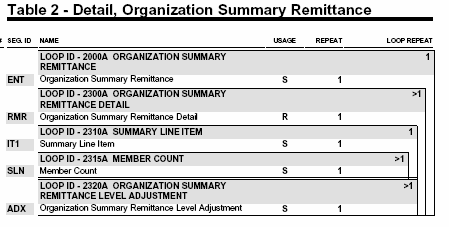
The "Summary Remittance"
The summary remittance is typically used when no detail on the covered individuals is needed. The transaction can tell how many people are insured (Member count), but we have no information on the names and numbers of those people.
Secondly, we have the "Individual Remittance" which lists every person for whose policy the remittance is.
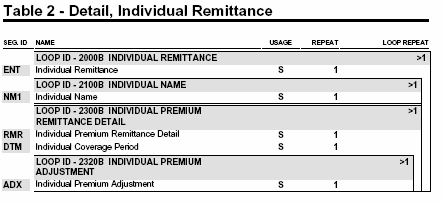
This version has a loop describing the individual policy holder and listing separately the benefits that this person subscribes to.
We decided to break the EDI record at the "ENT" level into individual records. Records share the EDI header with the payment, payer and payee information. This information is present in every record.
Under this Remittance header record are multiple policies with line detail information.