The HIPAA Authorizer has several features that enhance its capabilities and can be licensed individually. When you click under the Help the menu item Features and Licenses
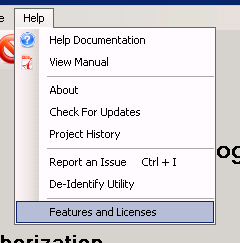
The 'Features and Licenses' menu
You will see the following form come up
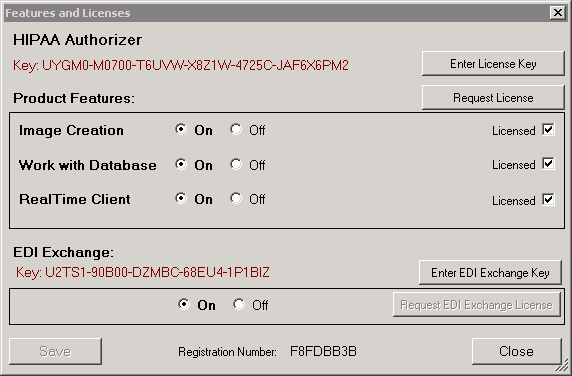
The 'Features and Licenses' form
Basic Version
The basic version of the HIPAA Authorizer has is capable in
request mode to
| o | Create 278 authorization requests |
| o | To load and read 278 authorization responses |
in response mode to
| o | Load 278 requests |
| o | Create 278 response |
This basic mode is quite limited but allows at a low cost to perform the most important task of the HIPAA Authorizer
Image Creation
The image creation feature allows to save the images of requests and responses into PDF or TIFF files. See the chapter on image file creation.
Database Connectivity
The true power of the HIPAA Authorizer requires the support of a database to its functionality. This way the program can write requests and responses to a database, keep track of received transactions and join requests with responses. In addition the program saves which user created a responses and places a time stamp to this information. All the setup information is then also stored in the database and provider, requesters and subscribers that have been manually entered can be saved and recalled for future use, cutting down on the time it takes to create a request significantly.
Real-Time Client
The affordable care act mandated that payers add real-time capability to their systems to answer requests by providers instantaneously. In 2013, this capability was required for eligibility and claim status transactions, 2014 added claim payment and in 2016 we will see the authorization transactions added to this requirement. The mechanics of Real-Time are quite complex. The Coalition for Affordable Quality Healthcare (CAQH) developed the CORE standards that underlie this requirement. Two very different transport mechanism have to be supported in order to become CORE certified as a payer. There is the MIME/Multi-part standard which is relatively old and goes back to email transactions with attachments, the second mechanism is SOAP, the Service Oriented Architecture Protocol, which is XML based and increasingly used in the communication between disparate computer systems. HIPAAsuite supports both protocols. You can set up a trading partner's transaction delivery mechanism to either MIME and SOAP and thus instantly send a request and receive the answer within 20 seconds. EDI Exchange is required for this feature.
EDI Exchange
EDI Exchange is a module that all HIPAAsuite application can share. It deals with the management of trading partner relationships, EDI transport, encryption and logging of received and sent files.